The Bible Records an Earthquake that Occurred at the Time of Christ’s Death
The Gospels of Matthew, Mark and Luke record a remarkable event at the moment of Christ’s death:
“And behold, the curtain of the temple was torn in two from top to bottom,
and the earth shook, and the rocks were split” (Matthew 27:51, ESV).
“But Jesus let out a loud cry and breathed His last. And the veil of the temple
was torn in two from top to bottom.” (Mark 15:37-38)
“The sun was darkened, and the veil of the temple
was torn down the middle.” (Luke 23:45)
These passages describe a literal earthquake that occurred in Jerusalem around the time of Jesus’ death on the cross, which took place in approximately 33 AD, signaling both cosmic and spiritual significance. The tearing of the temple veil symbolized humanity’s restored access to God, while the earthquake demonstrated the physical impact of this divine event.
Modern Science Provides Evidence that such an Earthquake Did in Fact Occur!
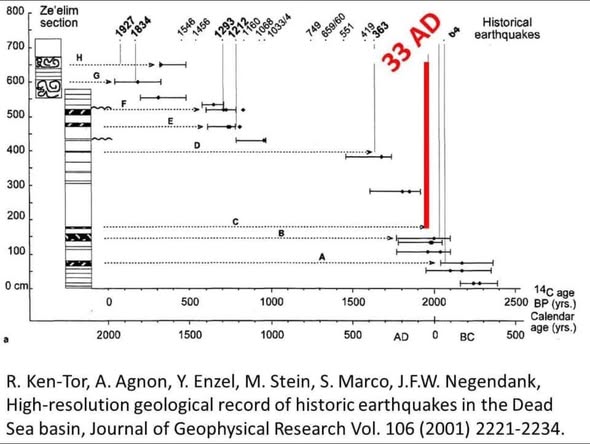
For centuries, skeptics have dismissed this account as symbolic or legendary. However, modern geology provides evidence that lends credibility to Matthew’s description. Studies of the Dead Sea Rift, a tectonically active region near Jerusalem, show that earthquakes have occurred repeatedly in antiquity. In particular, a 2011 study by geologists Jefferson B. Williams, Markus J. Schwab, and Achim Brauer analyzed sediment cores near the Dead Sea and identified a “seismite” — a layer disrupted by seismic activity — dated to roughly AD 31 ± 5 years. This notation indicates that the earthquake could have occurred anytime between AD 26 and AD 36, which overlaps with the traditional dates for Christ’s crucifixion.
This correlation between Scripture and geological evidence is compelling. While science cannot measure spiritual significance, the physical phenomenon of an earthquake at that exact moment aligns with the biblical narrative, supporting the historical reliability of the Gospel accounts. Earthquakes are not uncommon in the region, but the timing and description — shaking of the earth and splitting of rocks — suggest that the gospels of Matthew, Mark, and Luke were recording an actual event, not inventing a metaphor.
Science Once Again Confirms the Biblical Record
This convergence of biblical testimony and scientific observation strengthens confidence in the historical accuracy of the New Testament. It reminds believers that Scripture not only communicates spiritual truths but also records real historical events. The earthquake at the crucifixion serves as a powerful example: God’s intervention in history is tangible, observable, and corroborated by the natural world. The gospel writers were eyewitnesses to real, historical events. Thus, it should not be surprising to us that there is corroborating scientific evidence for this historical event.
Far from being purely symbolic, the shaking of the earth testifies to the reality of Christ’s death and the cosmic significance of His sacrificial work.
Sources:
Biblical Truth and Evidence: https://www.facebook.com/groups/434782062983116/
Journal of Geophysical Research Vol. 106
 Evidence To Believe